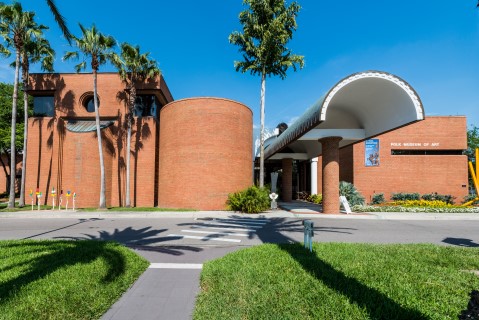
The AGB balances a historical sweep of art with lively, rotating exhibitions — think pre-Columbian artifacts rubbing shoulders with contemporary works, prints, modern photography, and regional pieces that tell stories about Polk County and central Florida. For the curious traveler who likes to poke around university galleries but dislikes sterile, overly curated spaces, The AGB has a comfortably lived-in feel: academic rigor without the arrogance.
At its heart the museum manages two complementary roles. First, it is an educational institution: students study, faculty teach, and the museum hosts classes and programs (drawing lessons, painting lessons, photography class offerings and occasional summer camps) that actively engage local learners. Second, it functions as a public-facing arts organization that programs exhibitions, community events, and small-scale receptions in gallery-adjacent event spaces. That dual identity gives the place an energy that feels both local and worldly. Visitors from out of town will find major threads of global art history woven into the galleries — pre-Columbian stonework and ceramics, prints and drawings tracing European and American modernism, and contemporary installations that change frequently, keeping repeat visits interesting.
The AGB’s permanent collection provides a backbone for the museum. It is not overwhelmingly vast, but it’s well considered. Many pieces are displayed to highlight cross-cultural dialogues: ancient objects alongside 20th- and 21st-century responses. For example, a visitor might see ceramics or ritual objects that suggest continuity with later-surface treatments in contemporary ceramics, or graphic prints that show technical lineage from earlier etchings. That kind of curatorial pairing helps the museums teach without lecturing. The exhibitions rotate on a schedule, so while a traveler may come for a particular show, they might also be pleasantly surprised by an artist talk, student curatorial project, or a pop-up photography presentation that wasn’t advertised months in advance.
Accessibility and visitor comfort are real priorities here. The museum typically offers onsite tours and has wheelchair accessible entrances, parking, and restrooms. The physical layout is compact and easy to navigate — a blessing for families with kids, travelers on tight schedules, or anyone who prefers to see a thoughtful museum without committing to an all-day slog. Restrooms and Wi-Fi are available; the museum doesn’t have a full-service restaurant, but there’s usually a modest café option nearby on campus and picnic spots for people who bring their own snacks. Free parking, both on-site and at nearby street spaces, removes one of the little travel annoyances that can sour a visit, so that’s worth a tiny fist pump in the parking lot.
Travelers who like to combine art with activities will appreciate The AGB’s educational programs and workshops. These are not just tourist trinkets; many of the workshops — think beginner drawing lessons or weekend painting sessions — are taught by practicing artists or college faculty and can offer a genuine hands-on connection to the museum’s collection and current exhibitions. There are also occasional photography classes and summer camps targeted at kids and teens. Families report that the museum is good for children: displays are approachable, docents do a decent job engaging younger visitors, and the hands-on program slate means that kids who fidget during long gallery tours still have things to do.
The gift shop deserves a mention. It’s small but curated with thought — prints, books, artist-made objects, and locally sourced items that reflect the exhibitions or the college’s arts-oriented culture. The prices are not outrageous for museum retail, and for travelers who prefer a meaningful memento over a mass-produced magnet, the shop is usually a hit. In other words, one can walk away with something genuinely tied to the experience rather than the usual airport detritus.
Event hosting is another piece of the AGB puzzle. The museum acts as an intimate event venue for lecture series, gallery talks, small receptions, and occasional community gatherings. That means if a traveler happens upon a Friday night opening or a public lecture, they can experience the museum in a more social, energetic mode. The rooms are sized for modest crowds; events feel curated and personal rather than overwhelming. On the flip side, this intimacy means that extremely large traveling exhibitions are unlikely — the AGB makes its strengths out of thoughtful, focused shows rather than blockbuster scale.
One of the reasons The AGB stands out in Lakeland’s cultural scene is its balance between regional focus and international scope. While several works highlight Florida and Polk County artists, there are also selections from Latin America, Europe, Africa, and Asia in both permanent and temporary displays. Pre-Columbian works, for instance, are presented with context, not mystification. Contemporary works often respond to global conversations about identity, place, and materials, and the museum’s programming tends to frame these conversations accessibly. Visitors who appreciate art history will find enough heft; those who simply want to be moved or provoked will likely leave with something to think about.
Visiting The AGB is also an opportunity to see how an art museum fits into a college campus. The surrounding architecture and the pedestrian rhythms of the campus add to the visit: students crossing pathways, posters for upcoming classes tacked to bulletin boards, and the sense that the museum participates in academic life. For travelers who enjoy that sort of atmosphere — less formal, more exploratory — the experience can feel refreshingly human. Bring a bit of patience on busy days, though; campus events can bump up foot traffic, particularly during exhibition openings or when class schedules align with public programming.
Not everything here is perfect. Because the museum is intentionally community-centered and educational, travelers expecting large-scale installations or every possible amenity will sometimes be disappointed. The AGB is not a museum of extremes; rather, it is a museum of relationships: between objects, between artist and audience, and between the college and the surrounding community. Expect depth over dazzle. Also, exhibitions rotate, so if one has a particular artist or era in mind, a quick inquiry before visiting is wise. Nonetheless, many visitors appreciate the museum precisely because it avoids spectacle and instead fosters quiet discovery.
For photographers and sketchers on the road, the AGB usually accommodates photography for personal use in galleries that allow it, though policy can vary by exhibition and by lender restrictions. Those interested in a more active creative pursuit should check the schedule in advance; drawing lessons and photography classes are offered periodically and can transform a brief stop into a memorable hands-on experience. Likewise, event planners and small-wedding parties occasionally book gallery-adjacent spaces, so travelers who want an artsy backdrop for a special moment sometimes discover this through the museum’s event calendar.
In practical terms, the museum’s combination of free parking, accessible facilities, onsite tours, and family-friendly programming makes it an easy stop for visitors exploring Lakeland and central Florida. It’s the kind of place a traveler can plan for a one- to two-hour visit and come away feeling they used their time well. People who enjoy museums that encourage interaction, learning, and quiet contemplation will find The AGB especially satisfying.
Ultimately, the Ashley Gibson Barnett Museum of Art offers a compact yet rich cultural experience. It is not trying to be everything; instead it leans into its strengths — thoughtful curation, community-oriented programming, and educational engagement. For a traveler who likes museums with personality and substance, The AGB is worth lingering over. And if a person leaves with a new perspective on pre-Columbian craft, a sketch in their travel notebook inspired by a contemporary print, or a small object from the gift shop that actually means something, then the museum has done its job. It makes art approachable without dumbing it down, and that balance, quietly held, is rarer than one might assume.
 Real Journey Travels