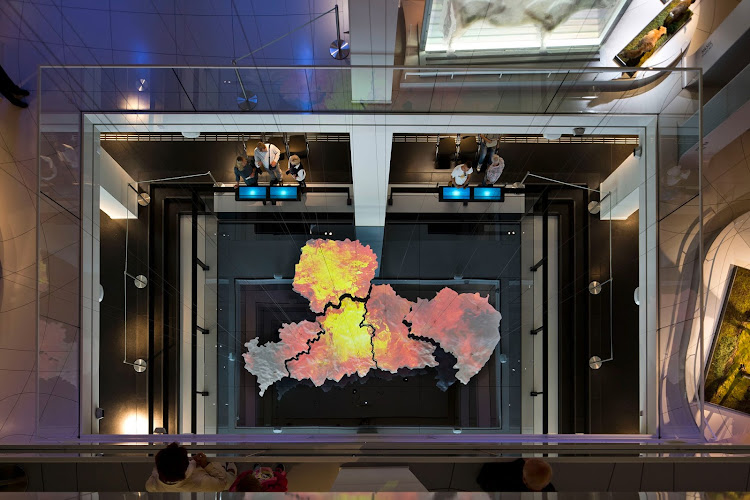
Housed in the striking former Schocken department store by Erich Mendelsohn, the museum merges architectural history with archaeological discovery: visitors move from an icon of New Building into an exhibition that feels equal parts time travel and design studio. On three floors the smac stages finds from local digs with a modern, multimedia vocabulary — projections, interactive displays, and sculptural installations — so that objects which might once have been boxed in back rooms now perform for an audience.
At the heart of the permanent exhibition is a handful of attention-grabbing anchors: a seemingly floating relief-map of Saxony that orbits regional finds; futuristic installations devoted to Neandertal research that do more than show bones — they invite questions about what it meant to be human tens of thousands of years ago; and those astonishing Neolithic wells, some 5,200 years old, reconstructed to give a sense of engineering and daily life in the late Stone Age. Then there is the long, more than 45-meter vitrines wall where everyday objects from the medieval period through the industrial age parade by in glass: shoes, tools, combs, fragments of pottery and glass — little, stubborn, meaningful things that quietly argue for the continuity between the present and the past.
The smac does not hide the fact that it is a state museum: scientific rigor and conservation practice are visible in labels, in laboratory-style displays and in the way objects are contextualized with maps, timelines and stratigraphic graphics. Yet the tone rarely feels dry. Curators have leaned into design, and often that pays off. A frequent visitor commented that the museum is like a conversation between an archaeologist and a museum designer — sometimes they agree, sometimes they argue, but the argument is interesting to watch. That imperfect, slightly quirky energy helps the smac avoid the usual museum doldrums: one moment a family presses a button to see how a Bronze Age axe might have been used (or misused), the next a student pores over microscopic images of pollen samples projected on a wall.
Accessibility and practical amenities are visible strengths. The main entrance and parking are accessible, assisted listening devices and hearing loops are available, and restrooms include wheelchair-accessible facilities and changing tables for small children. There is a restaurant inside the building for a relaxed break between floors (and yes, the coffee is a solid recovery tool after a long spell of historical immersion). Live performances and occasional special events lend a civic buzz to the place: think lectures, music, and family workshops that animate the exhibitions in unexpected ways.
Still, the smac is not without its trade-offs. On busy days the three floors can feel bustling and the multimedia installations may attract groups circling the same displays. A few visitors have found parts of the design a touch too high-tech for straightforward object appreciation — screens and projections sometimes compete with the artifacts themselves. Prices for temporary exhibitions, or for combined tickets with special events, can feel steep to those who expect a modest municipal museum. That said, most people walk away impressed by the breadth of material and the quality of interpretation.
What makes the smac especially worthwhile is its regional focus done well. Many European archaeology museums scatter attention across grand narratives; this museum chooses to probe Saxony specifically, and that regional angle yields surprising payoff. Thematic threads — agriculture, craft, settlement patterns, industrial change — are traced across centuries, showing the emergence of local identities, trade links (yes, even with distant regions), and technological shifts that shaped everyday life. One memorable section reconstructs the arc from hand-thrown pots to industrial glass production in Chemnitz, and it insists, with a kind of soft insistence, that industrial history is simply a very recent layer on top of a much older human story.
For families the smac often scores high marks. The museum is clearly child-friendly: the displays include tactile moments and kid-oriented explanations; changing tables and family restrooms eliminate a lot of small logistical headaches; and staff are used to leading workshops for younger visitors. Teenagers sometimes roll their eyes at introductory panels, but those same teens often find the Neandertal installations — which mix science with speculation — oddly compelling. Solo travelers and archaeology buffs will appreciate the depth of the collection: stratigraphy, skeletal remains, tools, and a surprisingly rich selection of smaller modulators of daily life that tell more intimate stories than grand monumental objects ever could.
Architecture lovers will also find a separate pleasure. The building itself, designed by Erich Mendelsohn as a department store, is part of the story. The smac devotes exhibition space to the building’s own past and the layered urban narratives around it. Visitors who care about modernist architecture will linger over photographs, plans and the salvaged details that sketch the department store’s heyday. It is a rare museum that manages to display both prehistoric wells and the design logic of a 20th-century storefront without either element feeling shoehorned in.
For travelers who like to plan, here are some practical impressions that tend to come up again and again. A full visit that explores the three floors and pauses at the highlights takes about two to three hours; quick visitors can see the main anchors in 60–90 minutes, but that leaves out much of the richness. Weekday mornings are calmer, and guided tours (when available) add value for those who want interpretive depth rather than free-roam browsing. The café is a good spot to regroup: its atmosphere is relaxed, not museum-cafeteria bleak, and offers a decent selection of snacks that help sustain a long afternoon of cultural consumption.
There are small surprises that reward attentive visitors. For example, the museum occasionally stages live performances that respond to archaeological themes — experimental music with prehistoric instruments, or theatrical readings that bring ancient texts into the contemporary city. These moments are the kind that create memories: a child dancing awkwardly to a reconstructed drumbeat, an elderly couple debating the accuracy of a Neolithic reconstruction, a student making notes into the dusk on a bench in the atrium. The smac, in short, manages to be scholarly and civic at once.
SEO-wise, the museum benefits from being prominent in Chemnitz and in the broader Saxony museum landscape. Keywords that resonate — archaeology Chemnitz, smac, Saxony prehistory, Erich Mendelsohn Schocken department store — all describe facets of the experience. Visitors searching for interdisciplinary stops that combine architecture, design and archaeology will find the smac a strong match. People who prioritize hands-on exhibits and multimedia storytelling will also find the museum aligned with their tastes; those who prefer cabinet-style, label-heavy displays might occasionally chafe at the theatricality.
In short, the State Museum of Archaeology Chemnitz is an engaging, sometimes theatrical, and often enlightening place. It delivers scientific substance without pretending to be austere, honors regional histories with international-quality interpretation, and situates its archaeological collections inside a building whose own history is exhibition-worthy. A visit here is likely to leave one with concrete takeaways — the image of a suspended map, the shockingly modern look of reconstructed Neolithic wells, small domestic objects that make centuries feel immediate — plus the sense that Saxony’s past is both longer and more inventive than many people assume. For travelers in Chemnitz with a curiosity about how everyday life evolved over millennia, smac is a destination that rewards attention, patience and the occasional, delightful digression.
 Real Journey Travels