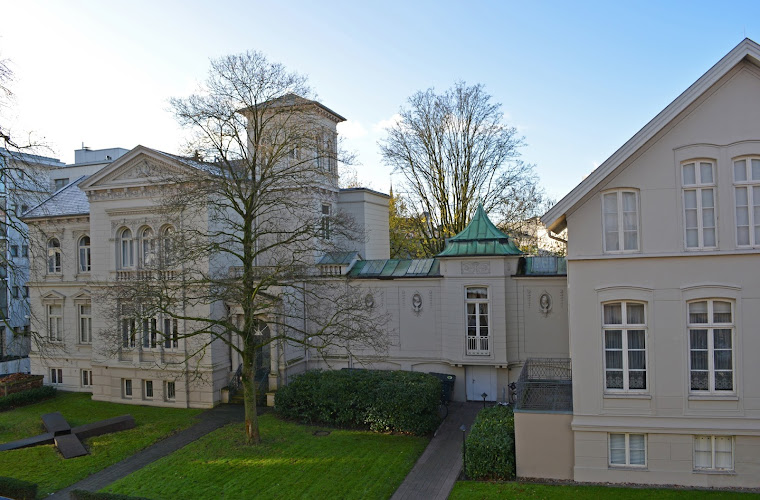
Housed in buildings that wear their history visibly — creaky staircases, plaster mouldings, and tall windows — the museum blends art, cultural objects, and the city’s own story into a series of intimate, often surprising exhibits. It is not a cathedral of glass and steel; it is a more human, house-like place, the kind of museum that invites lingering rather than hasty photo ops.
Visitors step inside expecting a single narrative and instead find overlapping layers: fine arts hung in salon-like rooms, domestic artifacts that sketch ordinary lives across centuries, and city-history displays that explain how Oldenburg evolved into the town it is today. The sense of discovery is deliberate. Galleries are arranged room-by-room, with each villa contributing its own character — one more formal and stately, another softer and domestic, the third flexible for rotating exhibits. Because of that layout, the museum rarely feels crowded even at busier times. People can wander, pause by a window, read a label, then move on when the mood strikes.
What distinguishes the Stadtmuseum Oldenburg is not merely the objects on display but the way they are presented in a domestic setting. Art works are mixed with everyday items — ceramics, textiles, portraits, and municipal artifacts — offering context that many modern museums strip away. This arrangement makes the museum particularly good at telling city-scale stories through the lens of personal, tangible things. For example, an ordinary household object can become a doorway into social change, migration patterns, or wartime adaptations. Those human-scale narratives tend to stick with visitors longer than facts on plaques.
Accessibility is a clear priority here. The main entrance provides wheelchair access, and there are wheelchair-accessible restrooms. That practical attention to visitors’ needs makes the museum usable rather than merely theoretically accessible. Families with young children also find it convenient: the museum is designed to be good for kids, with spaces that encourage short, curious stops rather than long lectures. A small but pleasant on-site restaurant offers a place to recharge, and well-maintained restrooms make longer visits comfortable. Practical amenities like these matter, especially after a morning of walking around Oldenburg’s city center.
The collection spans art and material culture, emphasizing local artists and objects connected to Oldenburg’s civic past. There is a tasteful balance between permanent exhibits and rotating shows, so frequent visitors will find reasons to come back. The temporary exhibitions often focus on regional artists, design histories, or thematic explorations of cultural life, and they tend to be curated in ways that complement the permanent displays rather than distract from them. Curators here evidently prefer depth over spectacle.
One little-known strength of the Stadtmuseum Oldenburg is its capacity to reveal side-stories of the city. For example, an exhibit might trace the development of a particular neighborhood through maps, school records, and family photos, making municipal history feel intimate and immediate. For travelers who like to understand a city beyond surface-level attractions, that’s gold. It’s the kind of content that fills in travel narratives: why a street looks a certain way, how a local tradition took root, which families shaped civic institutions. Those strands knit together to form a richer impression of Oldenburg than a single guided walk might provide.
Another appealing factor is the building ensemble itself. These villas were built for liveable, comfortable life rather than for exhibition, and that heritage gives the museum a domestic warmth that few museums replicate. In practice, this means lower, layered lighting, carpeted or wooden floors that dampen noise, and rooms that feel like someone’s preserved drawing rooms more than a gallery floor. It’s an advantage for anyone who likes museums that feel more like stories than showrooms.
For photographers and Instagrammers: the museum is tasteful rather than flashy. There are corners with elegant period architecture and light pouring through classical windows, but the museum’s primary aim is interpretation and reflection, not striking visual backdrops. That said, the quiet corners and well-composed exhibits are often photogenic — if visitors remember to ask about photography rules first and respect the quiet atmosphere.
The museum experience can be surprisingly flexible depending on how much time a visitor wants to spend. A focused quick visit of 45–60 minutes can capture the highlights: local portraits, a city-history walk, and perhaps a small temporary show. For those who like to read labels and take photos or snack in the museum restaurant afterward, a two-hour visit is comfortable. Scholars and deeply curious travelers can easily spend half a day exploring archives or following up on the rotating exhibitions that often include detailed, research-driven catalogues.
Staff are generally knowledgeable and approachable. They are content to give short highlights or longer background as requested, and because the museum is community-oriented, volunteers and curators sometimes share personal anecdotes about particular objects. Those insider comments add texture — anecdote about a mayor’s portrait that once hung in the town hall, a story about a local craftsman whose work surfaces across the collection. Such small human stories are what make the museum stick in the memory.
Practical planning tips appear throughout the visit. Signs are clear without being intrusive, and text panels are often bilingual, which helps international travelers navigate themes without feeling lost. The museum’s signage tends to favor thoughtful explanation over terse labeling; exhibit texts explain not just what an object is but why it matters to Oldenburg’s identity. That emphasis on context is excellent for curious travelers who want more than a list of names and dates.
There are occasional limitations too: because the museum occupies historic villas, some gallery sizes are constrained, and very large installations are not a fit here. And while the museum does a fine job of balancing art and civic history, travelers seeking blockbuster shows or large-scale contemporary art may find their expectations unmet. But for most visitors interested in regional culture, the Stadtmuseum Oldenburg hits the sweet spot between scholarly depth and accessible storytelling.
For families, educators, and culturally curious travelers, the museum offers a comfortable, human-scale experience. It’s the kind of place where a child might point excitedly at a toy from a century ago, prompting a conversation about how children played differently, or where a traveler might learn the local reason for a street name and then go see that street afterward with a new set of eyes. That linkage between museum and city walk is one of the museum’s quiet pleasures: it doesn’t isolate history into rooms — it points outward, toward the rest of Oldenburg, encouraging visitors to make connections across time and place.
In short, the Stadtmuseum Oldenburg is recommended for travelers who appreciate historical depth presented with a human touch. It’s not a destination for those looking for adrenaline or spectacle; it is, however, a place to slow down, be curious, and come away understanding Oldenburg better than one could from a map or a passing bus tour. The combination of historic villas, a thoughtful mix of art and city history, good accessibility, child-friendly elements, and an on-site restaurant makes it a practical and pleasurable stop on a cultural itinerary through Oldenburg, Germany.
 Real Journey Travels