
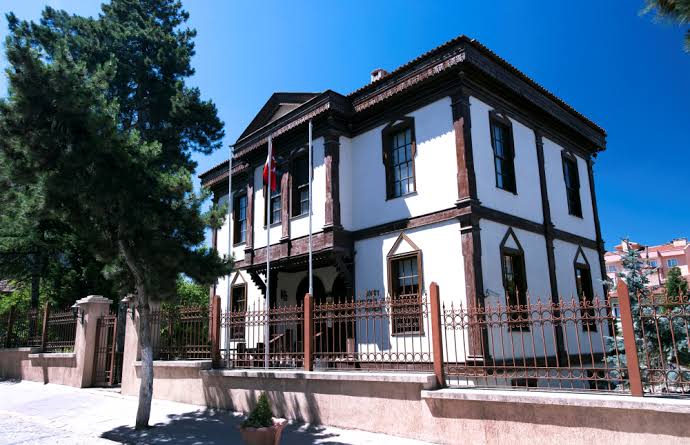
Söğüt Ertuğrul Gazi Museum
About Söğüt Ertuğrul Gazi Museum
The Söğüt Ertuğrul Gazi Museum presents itself as a quiet, thoughtfully arranged doorway into early Ottoman history, aimed at anyone intrigued by the very roots of a dynasty that reshaped Anatolia and beyond. The museum focuses on the life and legacy of Ertuğrul Gazi and his immediate milieu, using a compact but carefully curated mix of artifacts, replicas, and interpretive displays to tell a story that is both local and unexpectedly grand. Visitors will find a narrative that moves from everyday nomadic life to the stirrings of statecraft — all within rooms that feel more intimate than intimidating.
The building itself is modest, which is part of its charm. It refuses to shout. Instead, it invites a closer look: worn wooden cases, neatly labeled textiles, and vitrines housing metalwork and weaponry that suggest a history lived in practical terms — saddles, bits, arrowheads, a faded banner or two. It’s not a palace of gold and ostentation; it’s a place that highlights material culture and the human choices behind it. For many, that makes the experience feel honest and immediate. The museum’s layout encourages a slow, contemplative pace rather than a quick photo-op dash.
Accessibility has clearly been taken seriously. The entrance and parking area are wheelchair accessible, and accessible restrooms are available as part of the facility. That accessibility matters — not only for older travelers but for families with strollers and anyone who benefits from barrier-free spaces. Inside, display heights and pathways are generally considerate; the design choices favor clear sightlines and interpretive panels that are readable without crouching or stretching. These are small things that add up, and they make the museum feel welcoming rather than forbidding.
Interpretation leans toward the practical and explanatory rather than purely celebratory. Where some history museums slip into dry recitation, this museum occasionally takes a more human tack: short biographical panels, short anecdotes about daily life, and reconstructed scenes that hint at living habits. Children seem to engage with the displays more than one might expect — perhaps because the objects are tangible and concrete rather than abstract relics. The museum is noted as being good for kids, and indeed families often report that the hands-on vibe (and clearly visible, non-glossy artifacts) helps spark questions and conversation.
The exhibition strategy mixes original pieces with faithful reproductions. Genuine Ottoman coins and some period metalwork sit next to reconstructed weaponry and textile fragments. That balance keeps expectations realistic: not everything is an original that once belonged to Ertuğrul Gazi, but everything on display serves the larger story. For visitors keen on provenance, most items are clearly labeled with origin notes and context, which is helpful. The museum staff have a tendency to be quietly proud of the local provenance of many pieces — a local bow here, a donated manuscript there — and that local connection gives the collection an added depth.
What distinguishes the Söğüt Ertuğrul Gazi Museum from larger, flashier institutions is its focus and intimacy. Instead of attempting to cover the entire sweep of Ottoman imperial history, it narrows in on a formative episode and a geographical anchor. That focus allows for moments of genuine surprise: a simple household implement that reveals craft traditions, or a wall text that recounts a little-known regional custom. Those details matter. They transform the visit from a checklist item into a small, memorable lesson about cultural continuity and adaptation in the region.
Visitors who enjoy contextual storytelling will appreciate the way the museum strings together material culture, oral history, and regional lore. It is not a multimedia spectacle; the emphasis is on objects, their stories, and the narratives that tie them together. This means the museum rewards the patient. Stay, read, and let the layers of explanation accumulate. People who rush through will miss the quiet joy of finding a small ceramic shard or an embroidered sack that somehow bridges centuries of everyday life.
The museum environment also offers moments of sensory pleasure. The creak of old floorboards, the slightly cool, dry smell of archival cases, and the soft, measured lighting create an atmosphere that feels respectful and deliberate. It’s easy to imagine a scholar or a curious traveler lingering with a single display, tracing the history of a blade or the weave pattern of a textile. This is not a place designed for loud tours or megaphone narration; it’s designed for conversation, study, and reflective curiosity.
Practical facilities are straightforward. There is a restroom on site and free parking adjacent to the museum — both details that make life easier for day-trippers. There is no restaurant inside the museum, so visitors should plan accordingly if they intend to stay for several hours. Nearby cafés and small eateries in Söğüt tend to be simple and locally run; for many visitors, that becomes part of the charm: a chance to sit down afterward with a cup of tea and digest what they’ve seen.
On the interpretive side, the museum does a decent job of balancing national narratives with local perspectives. It recognizes Ertuğrul Gazi as a figure who is part legend and part historical actor, and the displays reflect that duality. The curatorial voice rarely indulges in myth-making; instead it frames stories with context and, importantly, caveats. That kind of honesty is refreshing. The museum is comfortable admitting uncertainty when sources are thin, and that honesty builds trust with visitors who come seeking facts rather than folklore alone.
One small quirk worth noting: the visitor experience can vary slightly depending on staff presence. On busier days, volunteers or docents may be on hand with extra tidbits and local color, while quieter days can feel almost meditative — in a good way. Either way, the museum’s core content remains consistent, and the lack of a crowded, scripted tour often allows for more genuine exchanges between visitors and staff. Those conversations frequently yield the most interesting insights, like an anecdote about a donated saddle or a local family’s oral history that adds human texture to the displays.
For history buffs, the exhibits provide useful stepping stones. Object labels point to further reading and suggest themes for deeper exploration: tribal confederations, frontier life, military technology of the 13th century, and the way local customs fed into larger political shifts. The museum won’t replace an academic monograph, of course, but it will provide a concrete, tactile foundation from which to ask better questions. And that’s really the point of a small, focused museum: to spark curiosity and point visitors toward further discovery.
Because Söğüt itself is a place tied to story and memory, the museum functions partly as a civic touchstone. Visitors often come away with a sense of how regional identity and historical interpretation intertwine — how a single figure can be commemorated in ways that reflect both historical research and local pride. The museum does not shy away from these layers; it invites them into the conversation. For travelers interested in the interplay between history, memory, and place, that makes the visit especially rewarding.
Finally, there is an understated emotional current to the museum’s narrative. It’s not melodramatic, but it is human. The items on display — worn leather, hand-forged bits, faded cloth — serve as quiet witnesses to lives lived under difficult conditions. For visitors who respond to human-scale history, the Söğüt Ertuğrul Gazi Museum offers small, resonant moments that linger long after the exit door closes. It’s a compact lesson in continuity: those who lived here centuries ago made choices and crafted objects that still speak to the present.
In short, the museum rewards curiosity, patience, and a taste for detail. It’s accessible, family-friendly, and grounded in local reality rather than grand spectacle. Travelers who value depth over dazzle — and who enjoy discovering the stories tucked into modest museum cases — will likely find the visit both informative and quietly moving.
Key Features
Söğüt Ertuğrul Gazi Museum
You Might Also Like

*BDT BELEK DOGA TOUR | Daily Tours, Day Trips and Excursions in Antalya*
1464. Sk. No:55
2006. Sk. No:2
Tours & Activities
GetYourGuide provides this tour inventory. We may earn a commission if you book through it; verify current availability, prices, and terms with the provider.
Visitor Reviews
There are no reviews yet. Be the first one to write one.
Share Your Experience
Have you visited Söğüt Ertuğrul Gazi Museum? Help other travelers by leaving a review.