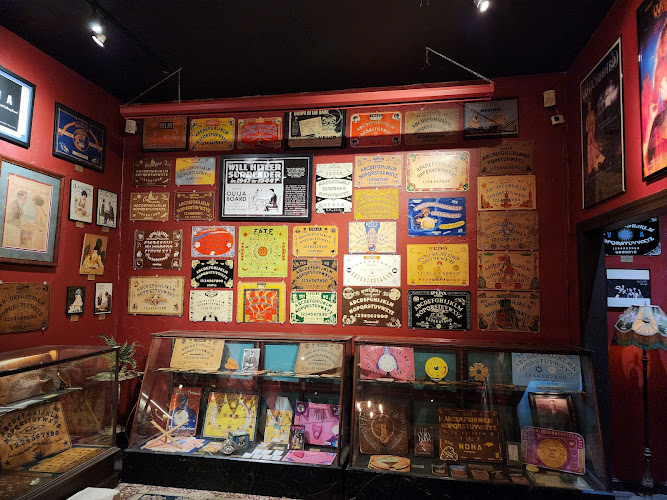
In the middle of Salem’s densely layered visitor landscape, Salem Witch Board Museum offers a narrowly focused look at an object many people recognize but rarely examine closely. The setting suits the city: Salem’s public identity is shaped by colonial history, witch-trial memory, Halloween-season energy, and a long-running fascination with the uncanny. Here, that fascination is approached through physical artifacts—boards, graphics, product design, and the stories attached to them—rather than through a broad survey of Salem history.
The museum’s appeal lies in the contrast between familiarity and detail. A Ouija board may seem like a game-night object, a spiritual tool, a pop-culture prop, or all three depending on the visitor. The collection provides a way to notice how those meanings have shifted over time. Visitors can compare changing visual styles and consider how manufacturers, believers, skeptics, and advertisers each helped shape the board’s cultural life. It is an especially fitting stop for travelers who prefer a compact, specialized museum to a large general collection.
What to See & Experience
The central experience is the chance to view a substantial range of historical witch boards and spirit boards in one place. Examples span different eras, from more ornate older designs to later twentieth-century styles, allowing the collection to function as a visual timeline. The museum also addresses the wider spiritualism movement and the commercial history behind the objects, placing familiar board imagery in a larger American context.
- Historical Ouija and spirit boards from a range of periods.
- An original Kennard parlor board dating to 1890.
- Changing typography, imagery, materials, and decorative styles.
- Interpretation of spiritualism’s influence on popular board culture.
- Vintage advertising and documentation of board marketing history.
- Rotating displays that may spotlight rare or unusual examples.
Take time to look beyond the planchettes and alphabet layouts. Details such as borders, illustrations, typefaces, patent-era language, and sales messaging reveal how companies presented these products to the public. Some designs lean toward parlor entertainment, while others borrow visual cues from mysticism or the occult. That tension is part of what makes the collection engaging: the boards can be read as household merchandise, as evidence of spiritual practice, and as artifacts of American graphic design. Visitors with an interest in antiques or advertising may find as much to study here as those arriving for Salem’s supernatural reputation.
Practical Visitor Strategy
| Planning Factor | Visitor Advice |
|---|
| Best Time to Go | Choose a quieter period outside Salem’s busiest seasonal peaks if you want more time with the displays. |
| Suggested Duration | Allow enough time to view the boards closely and read the interpretive material without rushing. |
| Crowd & Pacing Tips | In high-demand periods, build flexibility into your day and treat the museum as one focused stop among several. |
| Getting Oriented | Start with the earliest boards, then follow the changes in style, marketing, and cultural context across the collection. |
| Nearby Pairing | Pair the visit with Salem’s historic-center museums, independent shops, or a walk through the surrounding streets. |
Because Salem can feel particularly busy when seasonal programming and weekend visitors converge, it helps to decide what you want from the stop before arriving. Those seeking photographs, close visual comparison, or time to read labels will benefit from a slower pace. Those building a wider Salem itinerary can use the museum as a concentrated thematic visit between larger history sites. Confirm current admission procedures, accessibility details, and operating information directly through the place’s current listing before setting out, since visitor conditions can change.
Who Will Enjoy It Most (and Trade-Offs)
This museum is best suited to curious adults, older teens, collectors, design-minded visitors, and anyone interested in spiritualism, Americana, folklore, vintage advertising, or the history of consumer objects. It also works well for travelers who have already seen Salem’s more familiar landmarks and want a subject-specific experience. Fans of the eerie will find an appropriate atmosphere, but the strongest reward comes from approaching the collection with an interest in historical context rather than expecting a theatrical haunted attraction.
The trade-off is its intentional specialization. Travelers looking for a sweeping account of the Salem witch trials, extensive hands-on activities, or a large art-and-history museum may want to combine it with other stops. As with many visits in Salem’s historic center, comfort can depend on crowds, weather, walking conditions, and individual mobility needs; review current accessibility information before relying on a particular route or experience. Pairing the museum with nearby historic sites, local galleries, bookstores, or time exploring the central streets creates a fuller day while preserving the Witch Board Museum’s distinctive, artifact-led focus.
 Real Journey Travels