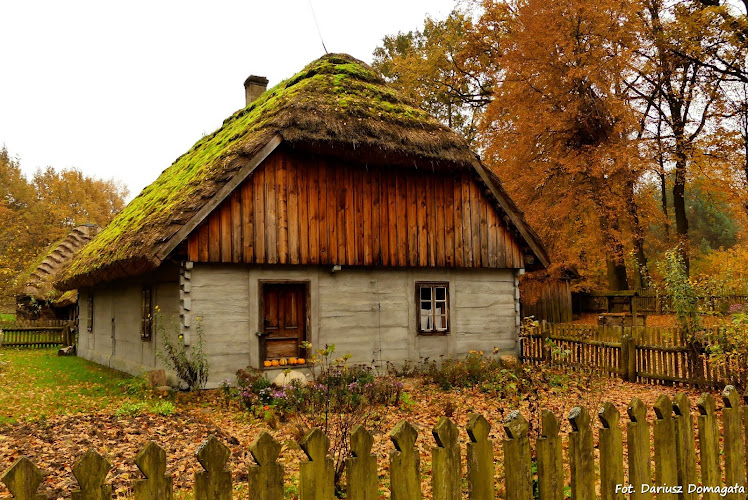
It stands as a museum of everyday history rather than a temple of objects, so people who expect polished showcases with velvet ropes may be surprised — in the best possible way. The emphasis is on architecture and experience: original or faithfully reconstructed structures arranged to suggest how local communities lived, worked and celebrated across the 18th and 19th centuries and into the early 20th century.
What makes this place different from many indoor history museums is the way it encourages movement and curiosity. Visitors wander from yard to yard, step over thresholds that still creak, and see interiors preserved or recreated with tools, furniture and domestic items. The Radom Countryside Museum highlights regional craftsmanship and folk culture, and it stages live performances of traditional music and seasonal fairs. Actors in period clothing and craftsmen working with wood or straw transform an ordinary visit into a short, sensory immersion in rural Polish life. A child is likely to remember the sound of a hand-mill for years; adults often remember the taste of rye bread freshly baked during a festival demonstration.
Although the core attraction is the reconstructed village, the museum curates rotating exhibits and themed events that deepen understanding of the region. Those exhibits might focus on agricultural tools, the interior of a manor house, or on religious and seasonal customs. The small scale of many buildings invites close study of vernacular architecture: thick beams, practical layouts, simple yet effective construction techniques. It’s an education in how form followed function in an era before mass-produced building materials. For anyone who appreciates architecture, even if they are not a highbrow fan of museums, the wooden buildings tell stories about climate, economy and social relations that a text panel rarely does justice to.
Accessibility and amenities have been thoughtfully addressed. There is a wheelchair-accessible entrance, parking and restrooms, which is not always a given at open-air heritage sites. The site includes gender-neutral facilities and a restaurant area where visitors can try basic traditional dishes. Families feel welcomed: the museum is frequently described as family-friendly with activities geared toward children, hands-on demonstrations and occasional workshops where youngsters can learn simple crafts. Those live performances often draw the largest and happiest crowds — a fiddler strikes up a tune, and suddenly the small square becomes festive. It’s informal, and that can cause the atmosphere to feel less like a curated space and more like a neighborhood event, which many visitors prefer.
From a planning perspective, the museum functions well as a half-day trip for travelers based in Radom or as a curious detour for people touring central Poland. It is close enough to the city to be practical, but far enough to offer a distinct change of pace. Guides and interpretive staff are usually available during peak times to contextualize the objects and buildings, and multilingual signage is increasingly common — though the quality of translation sometimes varies. And yes, some labels are brief; but the staff’s enthusiasm often fills the gap, especially during demonstrations. Visitors who ask questions tend to receive animated, knowledgeable answers, and that personal touch is one of the museum’s strengths.
There is a particular charm in the unscripted moments: a volunteer explaining how a cow’s yoke used to be fashioned, a blacksmith hammering at an anvil with rhythmic disregard for the smartphone era, or a sudden rain shower that turns a dirt lane into a mirror and makes the wooden facades glow. One frequent visitor remembers getting lost in a building for five extra minutes simply because the display suggested a life being lived there; they came away with a better appreciation for how intimate and crowded rural households could be. That kind of unexpected empathy — connecting modern instincts to long-ago practicalities — is a quietly powerful outcome of walking the museum’s paths.
Practical details matter, and the Radom Countryside Museum tends to cover the essentials without fuss. There are restrooms and a small restaurant offering local-style meals; it’s not gourmet dining but it’s honest and comforting. Tickets are straightforward; special events sometimes require advance purchase. During festivals and school holidays the grounds fill up, but the layout of the village allows for pockets of quiet — a bench under an old oak, the chance to listen to birds rather than commentary. For photographers and amateur historians, the site offers both wide compositions of architectural clusters and intimate portraits of tools, textiles and interiors. So bring a camera, though the real memories are often the ones you take without devices: a child’s squeal at a puppet show, the aroma of oven-baked bread, the dust motes in a shaft of light through a timber window.
For travelers coming from further afield, the museum pairs well with other cultural sites in the Radom area. A day may be split between this open-air museum and a nearby town center or gallery. That said, the site sometimes surprises those who arrive with only a superficial interest in heritage: the combination of reconstructed buildings, active demonstrations and occasional festivals raises engagement beyond what static exhibits usually achieve. The staff have experimented over the years with curricula for school groups and programs for families, and these educational offerings are usually well-executed. It’s the kind of place where a classroom full of children can watch a weaving demonstration and then try a loom themselves; those moments of participation tend to lodge in people’s memories longer than any label ever could.
There are a few imperfections worth mentioning honestly. The weather has an outsized influence on the experience: muddy paths can make parts of the site less pleasant in early spring or after heavy rain. Some buildings are only partially accessible internally to maintain their integrity, so if someone needs to rely on ramps they may not get inside every structure. Signage quality varies, and while live demonstrations are a highlight, their timing may not always align with a visitor’s schedule. Nonetheless, the overall impression is of a place committed to authenticity and public engagement rather than theatrical perfection. That commitment shows in the earnestness of the interpreters and the close attention to detail in reconstructed interiors.
From an SEO standpoint, the museum is often searched under terms like Radom Village Museum, open-air museum, wooden buildings, and heritage park in Radom, Poland. Travelers who look for hands-on heritage experiences, regional architecture or traditional Polish rural life tend to find it rewarding. Event-based visits — particularly for folk festivals, craft fairs and seasonal markets — amplify the experience, as local food, music and craft combine into something memorable and immediate. The calendar of events is worth checking, especially for visitors who want to catch a live performance or a harvest-time demonstration.
Visitors who value accessibility, family activities and a sense of living history will likely appreciate the Radom Countryside Museum. It is not an overly curated, glossy attraction; instead it offers a textured, sometimes gritty reminder of how ordinary people lived. For someone who wants to move beyond museum vitrines and actually feel the grain of a wooden beam under their palm, this museum delivers. Even those who come seeking quiet observation often end up participating, whether by tasting a traditional snack, watching a craftsman at work, or simply listening to a story about the region’s customs. It is a place where regional identity is performed and taught in small, durable ways — the kind of experience that lingers after more conventional sightseeing has faded into the background.
In short, the Radom Countryside Museum is a practical, thoughtfully arranged open-air heritage site that balances authenticity with visitor comfort. It puts traditional Polish rural life on display not as an exotica but as an ongoing conversation between past and present. And for many travelers, that conversation is exactly what they came to Radom to find.
 Real Journey Travels