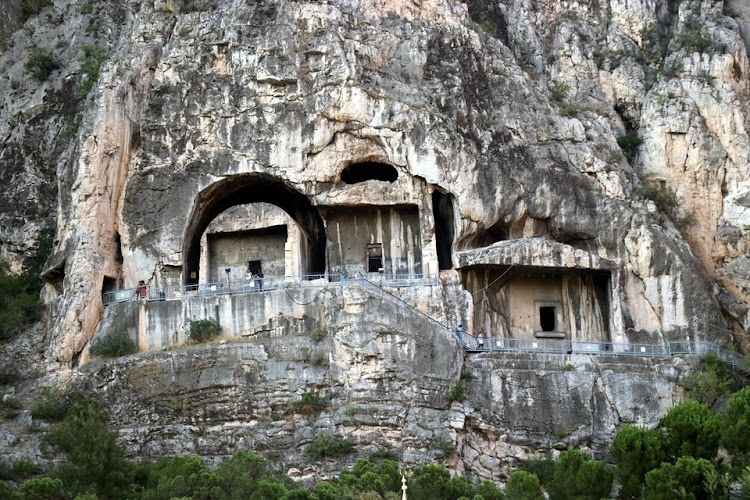
The Pontic Kings Rock Tombs are the monumental signature of Amasya’s ancient skyline: a series of royal burial façades cut high into a steep limestone cliff above the Yeşilırmak River corridor. Associated with the rulers of the Kingdom of Pontus, whose capital was Amasya during the Hellenistic period, the tombs date principally to the 3rd and 2nd centuries BC. Their position is integral to their impact. Rather than being displayed in a gallery, they remain embedded in the dramatic terrain that shaped the city’s history.
From below, the tombs read as imposing architectural forms carved from the mountain itself. Large arched openings, recessed façades and the considerable scale of the chambers communicate the prestige intended for their occupants; individual façades are commonly described as roughly 8 to 15 metres high. The site is often cited among Anatolia’s largest rock tomb complexes. It is also a rewarding urban viewpoint, linking the ancient cliff face with Amasya’s river, traditional houses and surrounding hills.
Standout Highlights & Experience
This is an open-air archaeological stop where landscape, monumentality and observation matter as much as close-up interpretation. Take time to view the tombs from different points on the approach before climbing, then slow down at the upper sections to appreciate how deliberately the royal necropolis was placed above the settlement.
- Monumental rock-cut façades: Look for the tall, round-arched entrances and formal symmetry carved directly into the limestone.
- Hellenistic royal context: The tombs evoke Amasya’s role as an early capital of the Pontic kingdom, rather than a later Ottoman-era cityscape.
- Cliffside scale: Viewing the façades from the base is essential for grasping their height and the effort involved in their construction.
- Yeşilırmak valley outlooks: Elevated viewpoints reveal the river corridor and the tightly layered historic fabric of Amasya below.
- Changing light on stone: Soft morning or late-afternoon light can make the relief, recesses and warm limestone tones easier to distinguish.
- Amasya’s paired landmarks: The tombs create a memorable visual dialogue with the hillside fortifications and old-town riverfront.
Practical Visitor Strategy
| Factor | What to Know |
|---|
| Best Time to Go | Go in cooler morning or late-afternoon conditions for a more comfortable climb and clearer, gentler light on the cliff. |
| Suggested Duration | Allow about 45 to 90 minutes for the approach, stair sections, monument viewing and time at the overlooks. |
| Crowd & Entry Tips | Arrive earlier in the day when possible. Treat it as an outdoor heritage walk; access arrangements can change, so confirm current conditions locally. |
| Getting Oriented | Start by locating the tombs from the riverside or lower city, then use the changing perspective to understand their commanding cliffside setting. |
Wear shoes with reliable grip and carry water in warm weather. The route involves stairs and uneven outdoor surfaces, so the experience is more enjoyable when approached at an unhurried pace. If upper access is restricted or the climb does not suit your group, the lower viewpoints still provide excellent appreciation of the façades and their relationship to the city. Photography is especially effective when the tombs are framed with the river valley, but a closer look at the carved architectural outlines adds the historical dimension that wide views alone can miss.
Honest Fit: Who Will Love It (and Trade-Offs)
This is a strong choice for history-minded travelers, archaeology enthusiasts, photographers and visitors who enjoy walking through a city’s past rather than viewing objects solely indoors. Families with confident walkers can find the scale engaging, while independent travelers will appreciate that the tombs sit within a broader day of exploring Amasya. The principal trade-off is physical: the steep hillside, stairs and uneven terrain may be difficult for visitors with limited mobility, strollers or anyone uncomfortable with heights and sustained climbing. There is relatively little shelter on the exposed route, and the site is better understood as a short, atmospheric archaeological ascent than as a fully interpreted museum visit. Pair it with a walk along the Yeşilırmak, time among Amasya’s Ottoman-era riverside houses, Amasya Castle viewpoints or the Amasya Museum for additional historical context. Together, these stops show how the city’s ancient, medieval and Ottoman layers occupy the same narrow and striking valley.
 Real Journey Travels