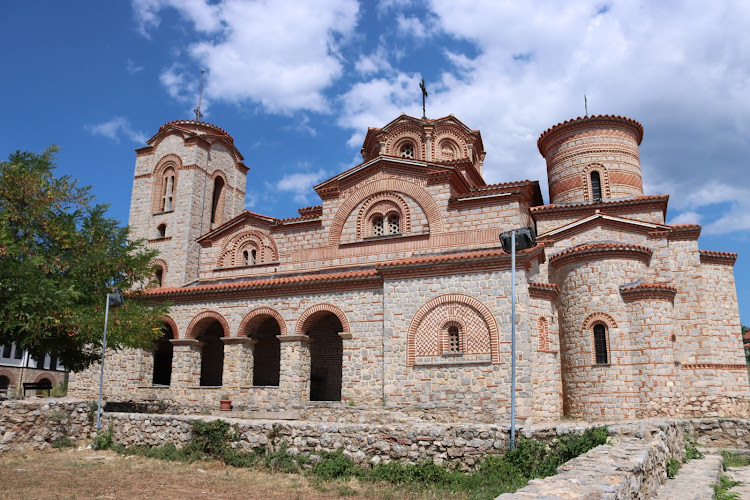
Above Ohrid’s old town, Plaoshnik Archaeological Park has the quiet, exposed character of a working historical landscape rather than a sealed museum. Paths move between low stone walls, excavated foundations, planted areas and the prominent Church of Saints Clement and Panteleimon, while Lake Ohrid opens out below the slope. The setting gives the visit two distinct pleasures: reading the evidence of former buildings underfoot and pausing for the wide view across one of Europe’s oldest lakes.
Plaoshnik matters because several eras of Ohrid’s religious and cultural history are visible in a compact area. Early Christian structures, including the remains of a basilica and baptistery, predate the medieval traditions associated with St. Clement of Ohrid. The site is also linked in local historical memory with Clement’s educational work and the literary culture that helped establish Ohrid as a major spiritual centre. The rebuilt church provides a clear focal point, but the smaller archaeological traces are what make the park feel layered and revealing.
What to See & Experience
Start by taking in the overall layout before concentrating on individual details. The contrast between the church’s finished form and the open excavations makes it easier to understand that Plaoshnik was not one isolated monument, but a place repeatedly adapted for worship, learning and community life. Interpretive material, where available on site, can help place the foundations in sequence; even without it, the differing wall lines and preserved surfaces reward slow looking.
- Look for the outlines of the early Christian basilica around the main church area.
- Notice mosaic remnants and surviving floor sections from earlier sacred buildings.
- Examine the baptistery remains, an important clue to early Christian ritual life.
- View the Church of Saints Clement and Panteleimon as the site’s architectural anchor.
- Pause at the open edges of the park for Lake Ohrid and hillside panoramas.
- Trace how excavation zones reveal overlapping construction phases and changing use.
The strongest experience comes from connecting these elements rather than treating them as separate photo stops. A mosaic fragment can point to an earlier church floor; a wall foundation can show the footprint of a building no longer standing; the church above them reflects the enduring importance of this hill. Light changes the mood considerably, with stone details often easier to read when the sun is lower and the lake view softer. Keep voices low around worship spaces and give archaeological areas the same care you would in a museum.
Practical Visitor Strategy
| Planning Factor | Visitor Advice |
|---|
| Best Time to Go | Choose cooler morning or later-afternoon light for a more comfortable walk and clearer lake views. |
| Suggested Duration | Allow roughly 45 to 90 minutes, longer if you enjoy architecture, history or photography. |
| Crowd & Pacing Tips | Walk beyond the church first, then return through the excavations at a slower, more observant pace. |
| Getting Oriented | Use the church, basilica remains and lake-facing edge as simple reference points around the site. |
| Nearby Pairing | Combine with Kaneo, the old town’s historic lanes, or other lakeside viewpoints in Ohrid. |
Approach Plaoshnik as part of a walking day in the old town rather than as a quick roadside attraction. The route through Ohrid’s upper historic quarter can involve inclines, so comfortable footwear is useful. Bring water in warm weather and leave room in your schedule for the approach and departure, both of which can be as scenic as the park itself. Conditions at an active heritage setting can change, and visitors should follow any on-site guidance concerning access to particular excavation areas or church spaces.
Who Will Enjoy It Most (and Trade-Offs)
Plaoshnik is especially satisfying for travelers interested in Byzantine and early Christian heritage, archaeology, Orthodox tradition, or the historical identity of Ohrid. It also works well for photographers and reflective sightseers who value a place with both close-up texture and a large natural backdrop. Families with curious older children can use the visible foundations as a prompt to imagine how a basilica, baptistery and medieval religious complex once functioned. Visitors seeking a calm counterpoint to the busier waterfront will appreciate the park’s more contemplative rhythm.
The trade-off is that much of the appeal lies in interpretation rather than spectacle: several remains are low, fragmentary and best appreciated with patience. Uneven ground, stone surfaces and sloping approaches may be challenging for visitors with limited mobility, and the outdoor setting offers limited shelter from strong sun or rain. Pair the visit with Kaneo for another celebrated church-and-lake setting, then continue toward Ohrid’s old town for cafés, lanes and additional monuments. That sequence gives Plaoshnik its proper context: not an isolated ruin, but one important chapter in a densely historic lakeside city.
 Real Journey Travels