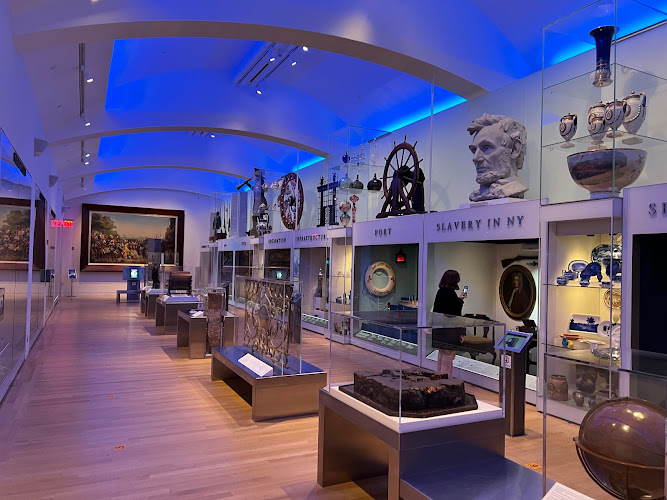
The New-York Historical Society is one of the city’s essential places to put New York into context. Founded in 1804, this Upper West Side museum and library traces the overlapping stories of the city, the state, and the nation through art, documents, furniture, photographs, decorative arts, and objects of everyday life. Rather than offering a single chronological march through the past, it uses its collection and changing exhibitions to show how power, migration, culture, commerce, conflict, and civic life have shaped New York.
Set on Central Park West near the park’s west side, the institution makes a rewarding cultural stop for visitors exploring the Upper West Side. Its subject matter ranges far beyond famous landmarks and political headlines: galleries can connect grand paintings and historic furnishings with the lived experiences of women, children, workers, immigrants, and communities whose stories have often received less attention. The result is a museum that suits dedicated history fans but remains approachable for travelers who want a richer sense of place before continuing through Manhattan.
Standout Highlights & Experience
The appeal lies in the range of material and the chance to see familiar New York narratives from less familiar angles. Give yourself time to read labels and follow the connections between artworks, artifacts, and archival material; the strongest discoveries are often the smaller, revealing objects rather than only the headline pieces.
- Look for paintings, manuscripts, maps, photographs, furniture, and decorative arts that document changing ideas of New York and America.
- Seek out exhibitions that examine civic debate, social movements, migration, and the people who helped build the city’s cultural identity.
- Spend time with the Center for Women’s History, which foregrounds women’s contributions and expands the traditional historical record.
- Families should look for the DiMenna Children’s History Museum, designed to make historical inquiry more tangible for younger visitors.
- Notice how major events are interpreted through both celebrated figures and ordinary New Yorkers, giving the galleries a more layered perspective.
- Check what temporary exhibitions, talks, films, or public programs are scheduled during your visit, as these can substantially change the experience.
Practical Visitor Strategy
| Factor | What to Know |
|---|
| Best Time to Go | Weekday visits generally offer more breathing room for reading displays. Arrive earlier in the day if you want a slower gallery experience, and check the museum’s current schedule before setting out. |
| Suggested Duration | Allow about 90 minutes for a focused visit, or two to three hours if you plan to explore special exhibitions, children’s spaces, and interpretive material in depth. |
| Crowd & Entry Tips | Exhibition changes, school breaks, weekends, and public programs can affect demand. Review current admission and timed-entry guidance directly before your visit rather than relying on old information. |
| Getting Oriented | Start with a gallery map and identify one or two subjects that interest you most. The museum is more satisfying when you prioritize instead of trying to absorb every label. |
For an efficient itinerary, begin with the exhibitions most tied to your interests, then leave room for a slower final pass through the collection galleries. The museum’s location also makes it easy to build in a park walk before or after your visit. If you are visiting with children, confirm which family-oriented spaces and programs are available that day, since programming and access can vary.
Honest Fit: Who Will Love It (and Trade-Offs)
This is an especially strong fit for travelers who enjoy art with historical context, New York enthusiasts, repeat visitors looking beyond Midtown’s major sights, families interested in hands-on historical learning, and anyone drawn to archival stories and changing exhibitions. It is less ideal for visitors seeking a quick, visually spectacular attraction with minimal reading: much of the reward comes from pausing over interpretation and connecting details across eras. The experience is primarily indoors, which can make it a useful rainy-day plan, though visitors with mobility, sensory, or family-access needs should review current access information and program details ahead of time. Pair it with time in Central Park, a walk through the Upper West Side, or another nearby cultural stop for a fuller neighborhood day; it works particularly well as the thoughtful, quieter counterpoint to the park’s open-air scale.
 Real Journey Travels