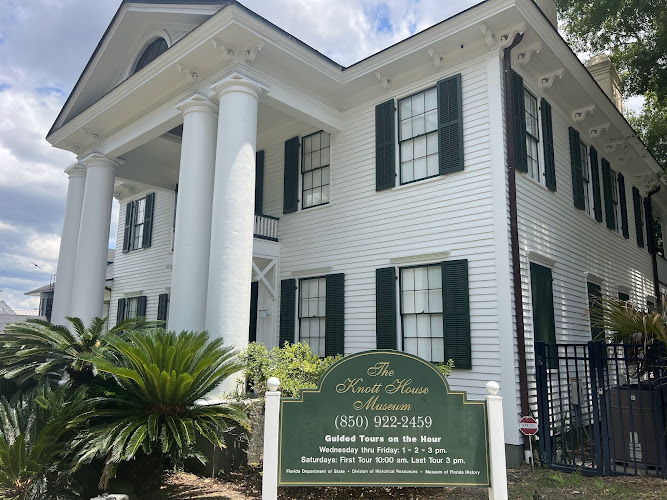
Built in 1843 as a private residence and later occupied for a short time by Union forces, the house now operates as a museum furnished with items dating largely from around 1928. That mix — an antebellum shell with early 20th-century interiors — gives the place a layered, lived-in feeling that surprises many first-time visitors.
Visitors will often remark on how the structure itself reads like a timeline. The exterior still carries the lines and proportions of a mid-19th-century Florida house: simple symmetry, tall windows, and broad rooms that once served social and domestic functions very differently than they do today. Inside, however, the circa-1928 furnishings create an unexpected jump forward in time: upholstery patterns, lamps, family photos, and household items that tell stories about life well after the Civil War. It’s not a museum that tries to be everything at once. Instead, it focuses tightly on the house, the Knott family, and the crucial historical moments that touched this address.
One of the key historical notes that gives the Knott House its particular weight is the reading of news of emancipation in Tallahassee at the conclusion of the Civil War. In May of 1865, Union cavalry entered the city and the house briefly served as headquarters; within days, former enslaved people learned of the war’s end and their freedom. That moment — the reading of emancipation-related news in and around the city — is still commemorated locally and is a focal point of the museum’s interpretation. For those who come looking for local ties to national events, the Knott House is a concentrated, tangible place to reflect on what emancipation looked like on the ground in a Southern state capital.
Because the museum’s scope is intimate, the labels and docent stories often shift the focus to individuals and small communities: the Knott family members, local freed people, and neighborhood life through the decades. The exhibits aim to bridge big-picture history with everyday details — a child’s schoolbook, household receipts, or a ledger page that anchors abstract historical forces to specific names and dates. As a result, the museum can feel more personal and less encyclopedic than larger institutions; that’s deliberate. People who prefer sprawling galleries and floor-to-ceiling artifacts might find it modest, but visitors who like close attention to context and story-telling will appreciate the concentration.
Another aspect that sets the house apart is its proximity to other historic sites along Park Avenue. The Knott House sits within an area dense with state and civic history, so many visitors pair a stop here with nearby museums and the historic Capitol. That makes the Knott House an excellent second or third stop in a day of historical exploration — a place to slow down after larger, flashier venues. The museum also hosts small-scale events and commemorations tied to emancipation and local memory; these often bring additional interpretive layers to the basic tour, including guest speakers, musical performances, or community remembrances.
It’s worth noting that the museum experience is built on a lot of volunteer effort and local stewardship. On different visits, guests overhear volunteers trading family lore or pointing out subtle details — a paint repair done in the 1940s, or a photograph tucked into a frame that offers an unexpected genealogy connection. Those human touches make the museum feel actively cared for, not static. If one wants a sense of living memory intersecting with archival care, this is where that happens.
For travelers who are used to flashy, interactive displays, the Knott House’s low-tech approach might be a surprise. But the calm, almost domestic atmosphere helps the stories land. The rooms feel as though someone might come back and sit in an armchair; that imagined continuity is a subtle, but powerful interpretive device. Artifacts are arranged to highlight domestic rhythms: breakfast at one table, a parlor piano that anchors social evening gatherings, and kitchen implements that nudge visitors to imagine the labor behind every day.
Practical history buffs will appreciate the specificity of dates and personalities on display. The construction year of 1843 is clear in exhibit narratives, and the interpretive material highlights the building’s changing uses over time — family residence, temporary military headquarters, and ultimately museum. The 1928-era furnishings, meanwhile, offer a distinct visual language that helps visitors connect early 20th-century life to the broader sweep of Florida’s social and cultural changes. Few places compress those strands so neatly.
On a more subjective note — and this is the kind of thing guides whisper about — the house has moments that linger. The parlor, with its sunlight through old glass, prompts conversations about fashion, music, and mobility in the early 1900s. The kitchen area, smaller than modern expectations, forces an acknowledgement of labor, of people whose names rarely dominate history books. And outside, the courtyard space where important proclamations were read, or at least where word spread, provides a quiet, reflective spot. Several local guides like to tell a small anecdote about an elderly Tallahassee resident who recalled attending an emancipation celebration as a child; those oral histories add texture that raw documents alone can’t provide.
For photographers and writers, the house offers arresting details: cracked paint that tells of countless repairs, a staircase that creaks in a particular cadence, light that slants differently in late afternoon. Because the museum isn’t a large, crowded site, there’s room to sit and jot notes or to linger and let small artifacts suggest larger stories. That said, the museum also respects the solemnity of some of its narratives; interpretation balances celebration and sober reflection in a way that feels thoughtful rather than performative.
Finally, the Knott House Museum delivers a concentrated lesson about how local histories intersect with national events. In a single visit, one can trace threads of Florida history, African American history, Civil War aftermath, and the evolution of domestic life. It’s not a flashy attraction; it’s a place that rewards slowing down, listening, and letting small objects speak. For travelers who enjoy context-rich stops and who like history served with a human scale, the Knott House offers more than a photo op — it offers perspective.
 Real Journey Travels