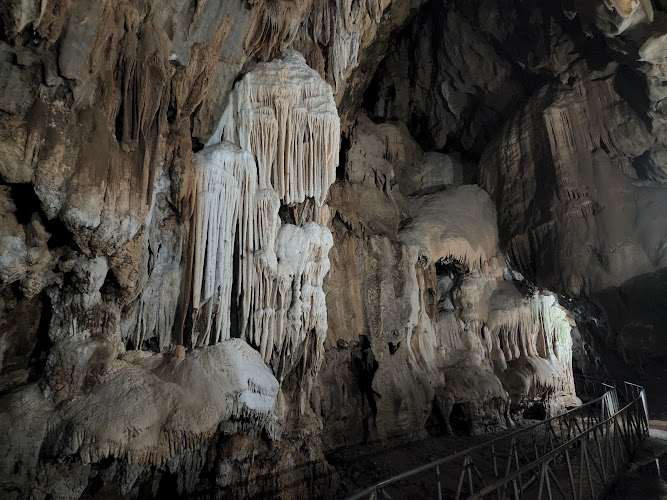
Cuevas de Talgua, widely known as the Cave of the Glowing Skulls, is a limestone cave system in the Olancho Valley of eastern Honduras, in the municipality of Catacamas. Local residents had known the cave for generations, but the inner ossuary chamber was only found in 1994, when explorers following the passage on the east bank of the Talgua River came across human bones roughly 600 metres inside. The nickname comes from the way light plays across the calcite that has crusted over the remains, giving them a pale, shimmering look. The site is managed by the Honduran Institute of Anthropology and History and operates as an eco-archaeological park, and visitors rate it highly (4.6 from 672 reviews).
The setting is rural and unhurried. The caves sit a short drive from Catacamas, one of Olancho’s two main towns, on a road that visitors consistently describe as good. Juticalpa is the other practical base. Few international travelers venture this far off the main Honduran circuit, so the visit feels more like a local outing than a tour-bus stop. Around the car park you may see mules and donkeys that farmers use to bring crops down toward town, a reminder that this is working agricultural country with humid tropical forest around the cave mouth.
Standout Highlights & Experience
The public visit covers a short, lit section of the cave rather than the sealed archaeological chamber. The main ossuary is not open to visitors, and the deeper areas remain under study, so set expectations accordingly: this is a geology-and-history walk, not a descent to the skulls themselves. A guide adds a lot, explaining how the bones were secondary burials, wrapped and carried in through an entrance that no longer exists, and later cemented in place by dripping, mineral-rich water.
- Illuminated cave passage: a walkway of roughly 500 metres with a sturdy railing leads into the cave, so footing is manageable.
- Stalactites and stalagmites: active formations shaped over millennia by dripping water, with cool, damp air inside.
- Calcite-glazed remains: the guided route gives you context on the glowing burials and the roughly 5,000-year-old story behind them.
- Ancient ceramics context: at least 20 intact vessels were recovered, some deliberately pierced in what researchers read as ritual practice.
- On-site museum: the entrance ticket has been reported to cover a small museum alongside the cave, which helps frame what you see.
- Forest trail: a walking path links the parking area to the cave entrance through green valley scenery.
Practical Visitor Strategy
| Factor | What to Know |
|---|
| Best Time to Go | Weekday mornings are the quietest. Weekends bring more local families. The dry season makes the approach trail easier, though the cave itself stays damp year-round. |
| Suggested Duration | Allow 1.5 to 2 hours for the guided walk, the museum and the trail, plus travel time from Catacamas. |
| Crowd & Entry Tips | Foreign visitors usually pay a higher fee than Honduran residents. Confirm the current price and opening hours locally or on the map listing, as both can change. Go with a guide. |
| Getting Oriented | The site is about 10 km from Catacamas by road. A private car or taxi is the easiest way, since public transport is limited. Tegucigalpa day trips are possible but long. |
Wear shoes with grip, since cave walkways can be slick, and bring a light layer because the interior feels cooler than the valley outside. Carry water and some cash, and keep a small flashlight or phone light for the trail back at dusk. Photography is usually fine in the lit passages, but follow your guide’s instructions and never touch formations or remains.
Honest Fit: Who Will Love It (and Trade-Offs)
This suits curious travelers interested in archaeology, caving and off-the-beaten-path Honduras, as well as families with older children who enjoy a short adventure. The railed walkway keeps the effort low, but the cave is humid, there are steps and slopes, and anyone with limited mobility should ask staff about the current route. Claustrophobic visitors may find parts of the passage snug. The main trade-off is that the famous glowing skull chamber cannot be entered, so the payoff is atmosphere and storytelling rather than a view of the bones up close.
Pair the cave with a stop in Catacamas for lunch and local markets, or build it into a wider Olancho loop through Juticalpa. Because services near the site are basic, plan food and transport before you set out, and aim to be back in town before dark.
 Real Journey Travels