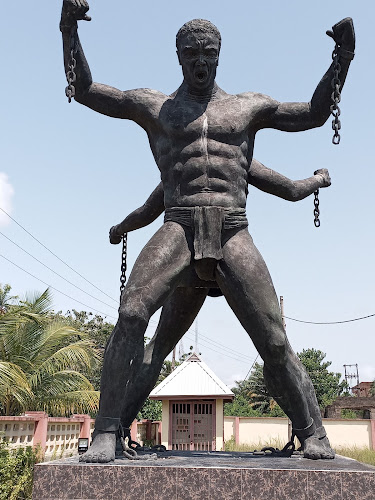
Built in 1863, the structure itself courts curiosity: thick walls, sun-worn staircases and rooms that still echo the administrative rhythms of a bygone era. Visitors who come for architecture stay for the story — and the story here is heavy, important and told with care.
The museum houses one of the most comprehensive exhibitions on the transatlantic slave trade in West Africa. Exhibits range from relics and objects used during the slave era to photographs, documents and interpretive displays that map the painful network of trade routes and human loss. It is both a repository and a memorial: artifacts are presented with contextual explanations that aim to connect the past with present realities. Many travelers find the rooms small but densely packed; the experience is compact, focused and difficult to forget.
Badagry itself played an outsized role in the history of slavery, often referred to historically as part of the European Slave Coast. Records indicate the transatlantic trade started in the area as early as 1473 and continued in various forms until 1888. Data cited by local historians suggest that during the peak years the region exported an average of 17,000 people annually to the Americas and Caribbean — a sobering statistic that frames the museum’s collections and narratives. Seeing chains, shackles, traders ledgers and the Point of No Return on the shore makes that number feel less abstract and more tragically human.
The Badagry Heritage Museum is not a neutral archive; it is a curated experience. Knowledgeable guides lead visitors through the exhibits, offering layered storytelling that includes local oral histories and documented accounts. The guided tour is often recommended; the guides are trained and they aim to balance factual detail with sensitivity. But notes of caution are warranted: the content can be emotionally intense, and some displays are stark. People who come with curiosity but little preparation sometimes find themselves struck silent in the small rooms where personal stories, lists of names and objects once attached to real lives are displayed. Yet most walk away feeling that the visit mattered — that it expanded their understanding of history in a way short web articles rarely can.
Apart from the internal galleries, the museum organizes curated trips to several nearby historical and recreational spots, tying the museum visit into a fuller exploration of Badagry town. Typical packages include the Point of No Return, the Akran Palace, Suntan Beach and Whispering Palms, with an eye toward affordability for groups and families. These add-ons help travelers see the town not only as a site of sorrow but as a living community with stories of resistance, governance and coastal livelihoods. For families, there are lighter moments: live performances that sometimes take place on the grounds, food at a local restaurant on site, and spaces where children can ask questions and move around without disturbing fragile displays.
The museum also highlights its accessibility features. There is a wheelchair accessible entrance and parking, and restrooms are configured to be inclusive, with gender-neutral options available. For travelers who plan ahead and have mobility concerns, these practical details make it far easier to organize a meaningful visit. The site identifies as women-owned and community-oriented; that shows up in the way tours are run and the local voices that appear in exhibition notes and performances. It makes a difference when the people who curate a place are from the community the history is about. It feels less like a detached lecture and more like a conversation across generations.
Visitors frequently remark on the contrast between the compact interior galleries and the open air sites nearby. The Point of No Return, for example, sits where the land visibly ends and the sea begins — a stark geographical punctuation to the museum’s interior narratives. The Akran Palace brings in a different register: local political history, kingship and cultural traditions that continued to evolve despite colonial intrusion. And then there are the beaches and palms where, on a hot afternoon, families picnic and children play. The proximity of those different scenes is jarring in the best possible way; it forces a visitor to hold the long arc of history in mind, to see sorrow and resilience within the same horizon.
Operation-wise, the museum runs guided tours that are usually the best way to grasp the nuance of the exhibits. Guides will point out small but telling details: the registration marks on ledgers, the ways oral histories diverge from colonial reports, the personal stories that are sometimes visible in a photograph or a journal entry. Travelers who skip the guide often miss the connective tissue that turns objects into a narrative. Still, self-guided visits can work for someone on a tight schedule, especially if that person reads slowly and carries questions. The staff can typically recommend a one-hour, two-hour or half-day itinerary that mixes museum time with outdoor visits.
One practical point that seasoned travelers appreciate: the museum is compact enough to be paired with other Lagos attractions for a long day trip, but remote enough that it rewards an early start. On weekends and public holidays it draws larger crowds — which is understandable — so weekday mornings often offer a quieter encounter. Photographers should also note that some exhibits are best experienced without flash; the museum’s lighting favors preservation over spectacle, which makes for moody, respectful photos but means a camera can struggle in certain rooms.
There is a particular human element the museum tries to preserve: local memory. Oral accounts recorded from elders, community performance traditions and even local craft displays sometimes appear alongside the main exhibits. Those moments are revealing because they show how a community remembers, mourns and celebrates simultaneously. It is not all solemnity. The live performances — drumming, storytelling and dance — are reminders of cultural continuity and serve as a kind of rebuttal to the erasure that centuries of forced migration tried to produce.
Travelers who have a personal connection to the African diaspora often find visits especially resonant. People looking for genealogical clues may be disappointed; the museum does not function as a genealogical archive in the modern sense. But the emotional resonance, the context and the artifacts can help frame personal histories in a larger narrative. For others, the museum provides an essential corrective to sanitized histories that omit the human cost of colonial commerce. There is learning here, and feeling; and both are necessary.
Not everything about the experience is pristine. Some visitors note that the small size of the building limits exhibition space, which sometimes leads to crowded rooms and lines for particular displays. The museum staff are aware of that and try to manage flow, but during peak times patience helps. Facilities such as a small restaurant on site provide basic refreshments, but those expecting gourmet dining should adjust expectations accordingly. Still, the convenience of a place to sit, drink water and process what one has just seen is welcome and often underappreciated in historical sites.
In planning terms, the Badagry Heritage Museum rewards curiosity and a willingness to sit with uncomfortable truths. It is educational, intensely human, and locally rooted. For the traveler who wants more than a quick photo op, this museum gives depth: context about the transatlantic slave trade, the regional role Badagry played, and the cultural legacies that survived and adapted. It does not shy away from difficult artifacts or statistics, and that honesty is part of its power.
Finally, the museum is a place where small acts of reflection matter. People leave notes in guestbooks, linger at certain displays, or join a local guide for a longer conversation after the formal tour ends. Those informal moments — a guide pointing out a tiny inscription, an elder sharing a family recollection, a child asking what an object was used for — are often the most memorable. They are reminders that history is not only found in documents and chains, but in the way communities choose to remember and teach. For travelers who care about history, context and conversation, the Badagry Heritage Museum is a stop that invites attention, reflection and a willingness to learn.
 Real Journey Travels