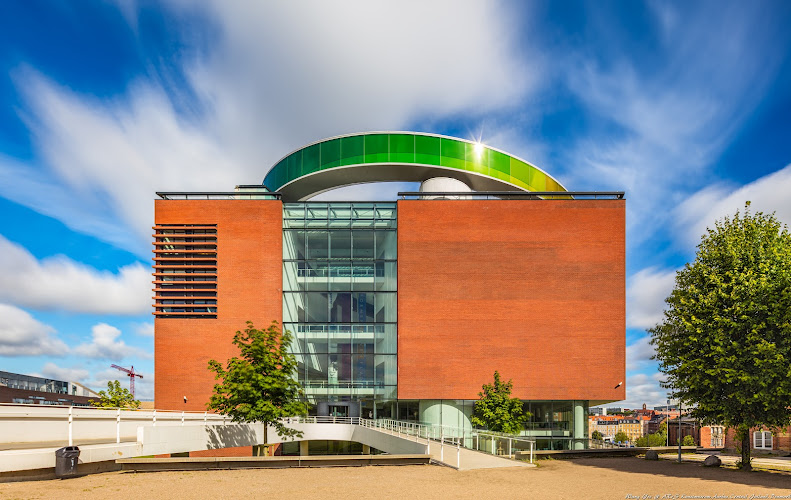
The museum houses a sweeping collection that traces Danish art from the 18th century to current contemporary practice, while also making room for international installations and experimental gallery projects. It is the kind of museum that rewards slow wandering: rooms of oil paintings and polite portraiture give way to large, sometimes disorienting installations, and then — almost as if by design — a circular panoramic walkway on the roof delivers a wholly different experience. Visitors leave having seen both art history and a piece of modern art infrastructure that doubles as a viewpoint above Aarhus.
The building itself is not merely a container. Designed by Schmidt Hammer Lassen, ARoS presents layered, light-filled galleries stacked like chapters in a book. There is an architecture to moving through the museum: low, intimate rooms invite quiet looking, and higher, more open halls create space for big, noisy installations. Galleries are arranged to let the collection breathe, and that matters. Too many big museums cram works in for density; here the rhythm between large-scale contemporary works and smaller historical pieces gives the visit a narrative arc. The public spaces feel intentional — generous staircases, long sightlines and a café area that conveniently surfaces at just the right moment when one needs to recover from an emotional encounter with a sculpture.
At the rooftop, the rainbow panorama by Olafur Eliasson functions as both artwork and destination. This circular, colored-glass walkway wraps the roof and refracts the city through saturated hues: the ordinary becomes cinematic. The panorama is tactile in the sense that you walk through it and the light changes as you do. People who come for art but stay for the view often mention how the rainbow alters perception of the city — and sometimes of themselves. It is an installation that invites photos, but it also rewards silence; step into a less busy color and the city sounds soften. The roof walkway ties into the museum program and the building’s identity in such an obvious way that, once seen, it is hard to imagine ARoS without it.
ARoS offers a broad program: permanent collections showcasing Danish painting and sculpture, rotating contemporary exhibitions that bring international artists to Aarhus, and commission-based installations that experiment with light, sound and space. Educational projects and family-focused activities often run alongside major shows, so there is an ongoing hum of workshops and guided tours, particularly at weekends and during school holidays. The museum’s curatorial approach is curious rather than didactic: it provokes questions more often than handing down answers. People who love context will appreciate the way explanatory texts and occasional multimedia guides fill in useful background without turning the galleries into textbooks.
Practical amenities are noteworthy and genuinely helpful for planning a visit. There is an on-site restaurant with seating that overlooks the city, a shop offering prints and locally made items, and free Wi-Fi in public areas — convenient for checking exhibition times or translating a wall text. Restrooms include gender-neutral facilities and changing tables for families, and the museum emphasizes accessibility with step-free entrances, wheelchair accessible restrooms and a parking lot that accommodates accessible vehicles. These details may seem small, but they affect how easy the museum is to enjoy for people with different needs. ARoS tries to be inclusive in both its physical design and its programming, and more often than not it succeeds.
One of the things visitors rarely hear in every guidebook is the odd juxtaposition of solemn, classical portraiture and playful contemporary work under the same roof. On one afternoon a group may gather silently before a 19th-century canvas; in the next room a child will be invited to rearrange blocks in an interactive piece. That contrast can be jarring — in a good way. It keeps the visit alive with sudden tonal shifts. The writer remembers arriving on a rain-splattered Tuesday and finding the museum half-empty; a solo afternoon turned into a private dialogue with several canvases and a long walk through Eliassons colored glass. It felt intimate, almost conspiratorial, and the memory still sits oddly sweet in the head whenever ARoS comes up in conversation.
ARoS also plays a larger civic role. Located near the cultural heart of Aarhus, the museum participates in city-wide events and festivals, often opening late for special programs or collaborating with performing arts partners. Exhibitions can be ambitious in scale: expect occasional large installations that require time and a bit of patience to appreciate. Because of that, planning helps. Visitors who try to rush through will likely miss the cumulative effect of the permanent collection followed by contemporary interventions. On the other hand, people who relish surprise will find themselves rewarded: a temporary exhibition might present a new voice that changes how they view works down the hall.
For travelers from outside Denmark, ARoS functions as a perfect introduction to Danish art and design thinking. The permanent collection situates contemporary experiments within a recognizable national lineage, while the temporary program signals how Danish museums engage with global discourse. Curators often program international names alongside Danish artists, which means one can go from seeing a local master to a cutting-edge international installation within a single afternoon. That blend makes ARoS particularly useful for visitors who want a compact but confident overview of art north of Copenhagen.
Visitors should also note the museum’s approach to sensory experiences. Many contemporary installations include audio elements, dimmed light or narrowly focused spotlights. Those elements create immersive moments, but they can be intense. Families and first-time museum-goers are encouraged to ask at the information desk about tactile or sound-heavy works if they have concerns. The staff are generally helpful and will point out quieter routes or hands-on family corners, which exist — yes, they do — and are a blessing when children need a practical way to engage with art without feeling bored or overwhelmed.
ARoS attracts a mix of local museum-goers, international tourists, design students and families. The atmosphere changes by the hour: morning visitors tend to be quieter, often older or on business trips; afternoon and early evening bring families and students, with social chatter and the hum of conversation in the café. Weekends and school holidays can be busy, so those wanting a calm, contemplative visit might aim for weekday mornings. For photographers and the Instagram-minded, the rainbow panorama is the obvious draw; for more contemplative art lovers, the museum’s layered galleries provide steady pleasures that reward time and attention.
One caveat worth mentioning: a few guests find the museum a touch overwhelming because of the scale and variety of programming. That reaction is understandable. ARoS can feel like a small city of artworks under one roof, and without a plan visitors may feel like theyre sprinting through instead of lingering. A recommended approach is to choose a floor or two to explore in depth, then take a break in the café before tackling the rooftop. That way the visit becomes a series of concentrated encounters rather than a blur. Also, budget time for the rainbow panorama. Even if it is busy, it is worth the slow walk around the ring; the colored light changes not only how the city looks but often how the rest of the day feels.
There are also small, practical pleasures that add up: a comfortable coatroom for rainy days, clear signage (mostly in English and Danish), and occasional evening openings with talks or music. ARoS is not a museum that hides its personality. It wants to be experienced, argued with, photographed, critiqued and, sometimes, loved. That candidness makes it worthwhile. People who love deliberate museum design will notice how exhibition flow and architecture converse, and those who care more about single, unmissable works will find the rooftop and a few signature installations precisely that.
In short, ARoS Aarhus Art Museum feels like a smart, occasionally playful anchor in Aarhus cultural life. It blends a solid historical collection with an appetite for contemporary risk, wrapped in architecture that invites movement and looking. For anyone planning a visit to get a sense of Danish art, modern Nordic museum practice, or simply to stand inside Eliassons rainbow and watch Aarhus refracted in color, ARoS is a memorable stop. The writer would add: bring comfortable shoes, leave time, and try to get slightly off-schedule — the unexpected encounter with a single painting or installation is often the memory that lasts.
 Real Journey Travels