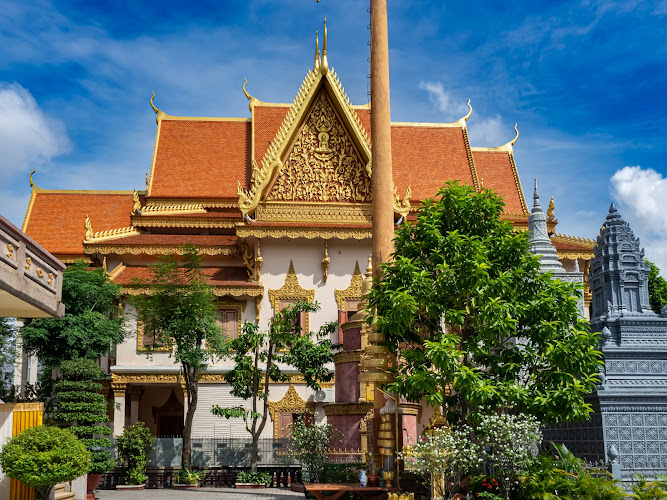
Wat Langka is one of Phnom Penh’s oldest Buddhist temples, with origins dating to 1422. Set just south of the capital’s central districts, the compound offers a quieter counterpoint to the city’s traffic-heavy boulevards and modern development. It remains an active place of worship rather than a museum: monks, local devotees and visitors share its courtyards, shrine spaces and shaded corners. That living religious role gives a visit more texture than a simple architectural stop, while also asking guests to observe temple etiquette.
The wat is associated with Cambodia’s Buddhist heritage and with historical links between Cambodian and Sri Lankan monastic traditions; its name recalls those connections. Within the grounds, traditional Khmer forms, ornamental roofs, gilded details and religious imagery reward an unhurried look. The atmosphere can shift through the day, from calm periods of prayer and routine to busier moments around observances. For travelers staying near the riverfront, Independence Monument or the central city, Wat Langka is an accessible cultural pause that can be approached as a brief visit or a more reflective stop.
Standout Highlights & Experience
Look beyond the headline architecture. Wat Langka’s appeal lies in the relationship between its historic standing, its functioning monastic community and the small details encountered while moving respectfully through the compound. Take time to notice how ceremonial structures, devotional objects and everyday temple life sit side by side.
- Historic roots: Explore a temple whose foundation dates to 1422.
- Living worship: Observe the rhythms of an active Phnom Penh Buddhist community.
- Khmer visual detail: Look for layered rooflines, decorative trim and gilded accents.
- Quiet inner grounds: Pause in the courtyards for a contrast with surrounding city streets.
- Buddhist learning tradition: Appreciate the wat’s long-standing religious and scholarly importance.
- Meditation context: The temple has been associated with Vipassana practice; arrangements can vary.
Practical Visitor Strategy
| Factor | What to Know |
|---|
| Best Time to Go | Earlier in the day is generally better for a calmer atmosphere and softer light. Avoid assuming that every area will be open or suitable to enter during ceremonies. |
| Suggested Duration | Allow roughly 30 to 60 minutes for a considered circuit of the visible grounds. Stay longer only if you are attending an activity with clear permission. |
| Crowd & Entry Tips | Enter quietly, follow any signs or local guidance, and do not interrupt worshippers. Religious dates and ceremonies can make the compound feel busier. |
| Getting Oriented | Begin at the main approach, identify active prayer areas, then circle the courtyards slowly. Keep photography discreet and ask before photographing people. |
Dress modestly, covering shoulders and knees where possible, and remove footwear when requested before entering a sacred interior. Speak softly, keep clear of monks and worshippers, and avoid pointing feet toward religious images. A small donation may be appropriate where a clearly marked donation box is provided, but it should never be treated as an entry requirement. If you hope to join meditation or a teaching, confirm the current arrangements in person and arrive with time to spare; temple schedules and access can change around religious life.
Honest Fit: Who Will Love It (and Trade-Offs)
Wat Langka suits culturally curious visitors, photographers interested in Khmer religious architecture, and travelers who prefer an active local temple over a heavily staged attraction. It is especially rewarding for those willing to slow down, observe etiquette and accept that a meaningful visit may be quiet rather than packed with interpretive displays. Families can visit with children who can remain calm and respectfully dressed. The experience is less ideal for anyone seeking a large-ticket monument, detailed English-language museum panels or guaranteed programming. Surfaces and thresholds in temple compounds can be uneven, and access to interiors may involve steps, so visitors with limited mobility should assess conditions on arrival rather than assume step-free access. Pair Wat Langka with a walk around Independence Monument or a wider exploration of central Phnom Penh, allowing enough time to move between contrasting city spaces without rushing the temple itself.
 Real Journey Travels